Background
In the previous ☞ article, we discussed how low-latency Shreds are a critical requirement in application scenarios such as block reconstruction, transaction signal capture, and transaction analysis. Fully leveraging low-latency Shreds can enhance business performance and secure a competitive edge.
Since the launch of BlockRazor's Solana transaction sending service, it has been well-received by numerous users. As an indispensable component of Solana's high-performance network, we deeply understand the importance of Shreds for projects. Therefore, leveraging our in-depth understanding of Solana's underlying mechanisms, we have been continuously exploring and developing the low-latency Shred service and officially launched the Solana Shred Stream on August 6, 2025 after extensive user testing and multiple rounds of optimization.
We conducted benchmark tests with Jito to compare the arrival times of matching Shreds. Searchers and quant trading systems can use earlier Shred data as an input for transaction-signal analysis, but this test measures delivery timing, not trading outcomes.
Methodology
Region
- Frankfurt
- Amsterdam
- New York
- Tokyo
Subject
- BlockRazor
- Jito
Steps
- Set up the benchmark client on servers (Teraswitch) in Frankfurt, Amsterdam, Tokyo, and New York regions to receive shred streams
- Jito: Deploy and start the Jito ShredStream Proxy on each server, configuring
BLOCK_ENGINE_URL,DESIRED_REGIONS, andDEST_IP_PORTSbased on the region - BlockRazor: configure the IP:Port for receiving shreds in the portal, select the region, and create 4 shred streams
- Jito: Deploy and start the Jito ShredStream Proxy on each server, configuring
- Parse the data of each shred, retrieve and record its slot and index, and log the source IP, destination port, and arrival time of each shred
- Deduplicate and count the total number of shreds received within one minute based on slot and shred index, differentiate shred providers by source IP and destination port, and calculate the proportion of first-arriving shreds per provider
- Calculate the arrival time difference (in milliseconds) between BlockRazor and Jito for the same shreds within one minute, and compute the quantile statistics for BlockRazor's shred arrival lead time compared to Jito
Data
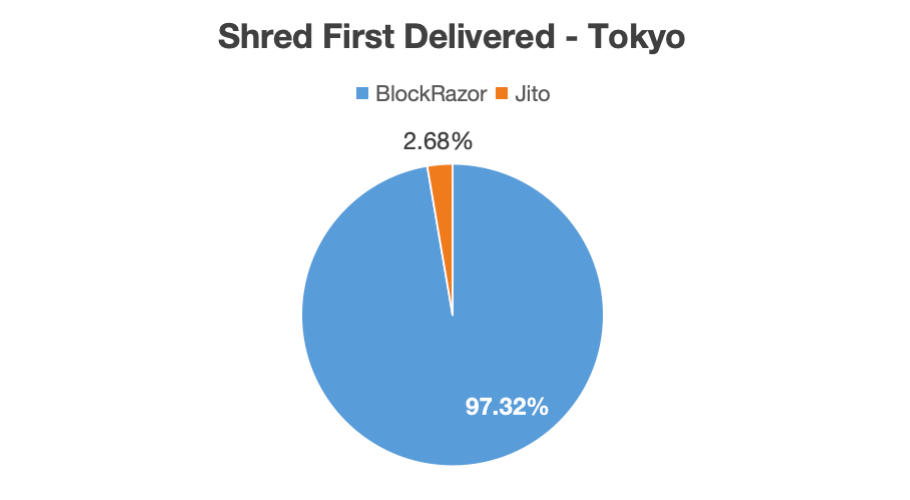
Proportion of shreds first delivered
Frankfurt
Amsterdam
New York
Tokyo
Summary
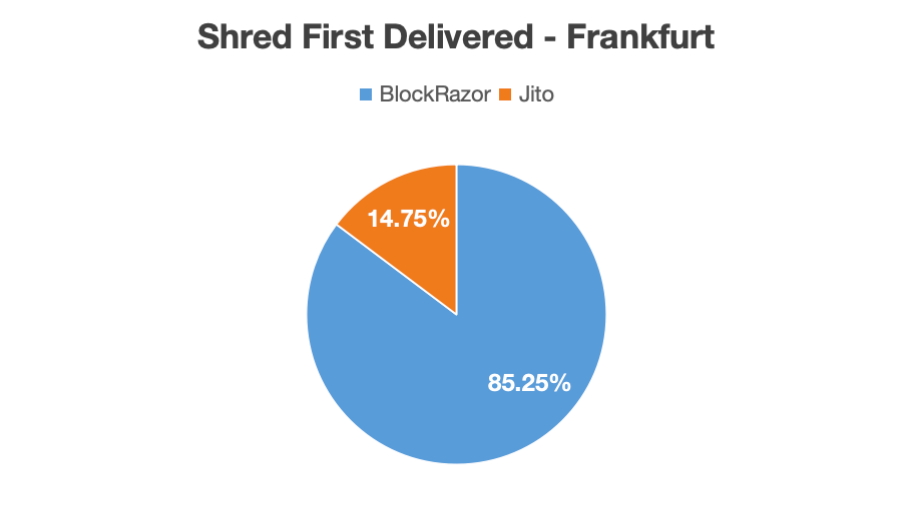
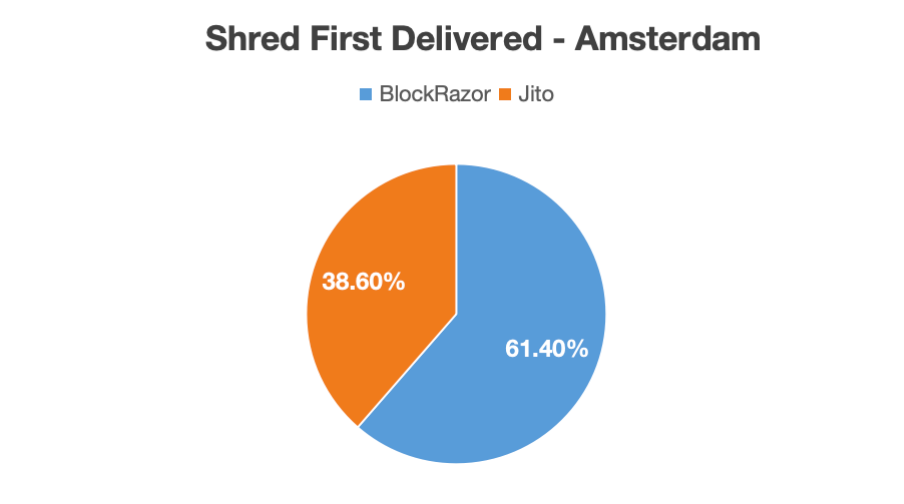
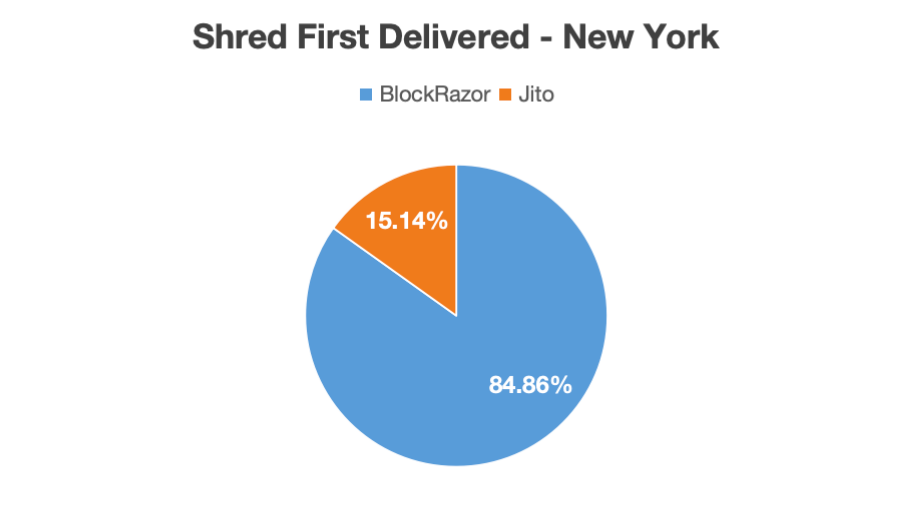
- Overall, BlockRazor holds a competitive advantage in all four regions, with the proportion of first-arriving shreds exceeding 60% in each. Jito's performance is consistently inferior to BlockRazor across all regions, with the proportion of first-arriving shreds ranging from 2.68% to 38.60%, showing regional variations.
- By region, BlockRazor performed most strongly in Japan (97.32%), followed by Frankfurt (85.25%), New York (84.86%), and lastly Amsterdam (61.40%).
Arrival Lead Time of BlockRazor Shred
Frankfurt
Amsterdam
New York
Tokyo
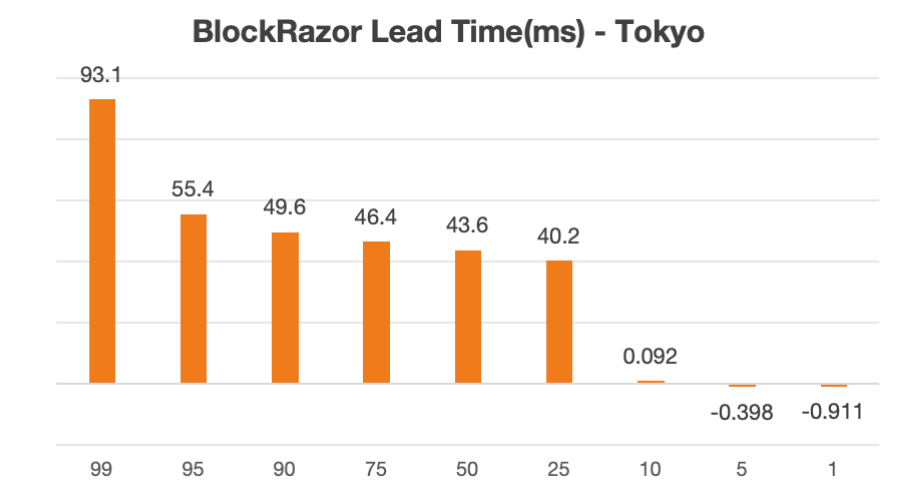
Summary
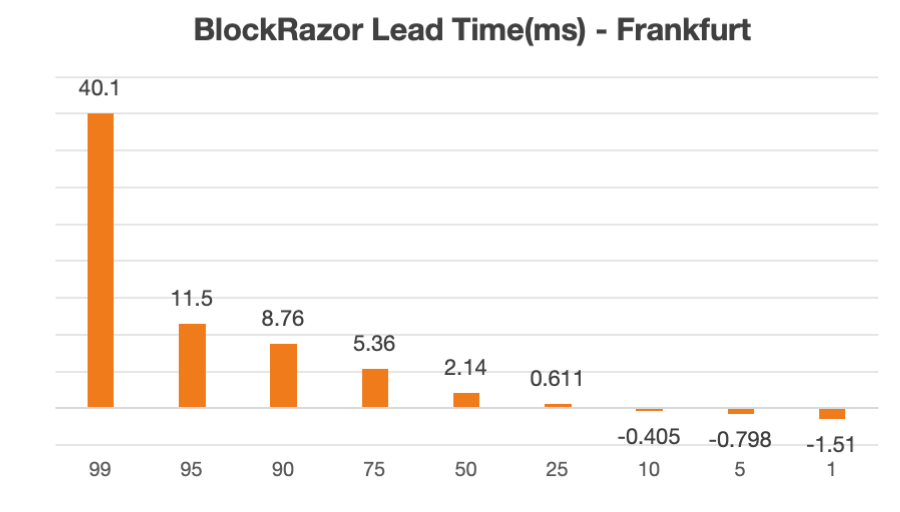
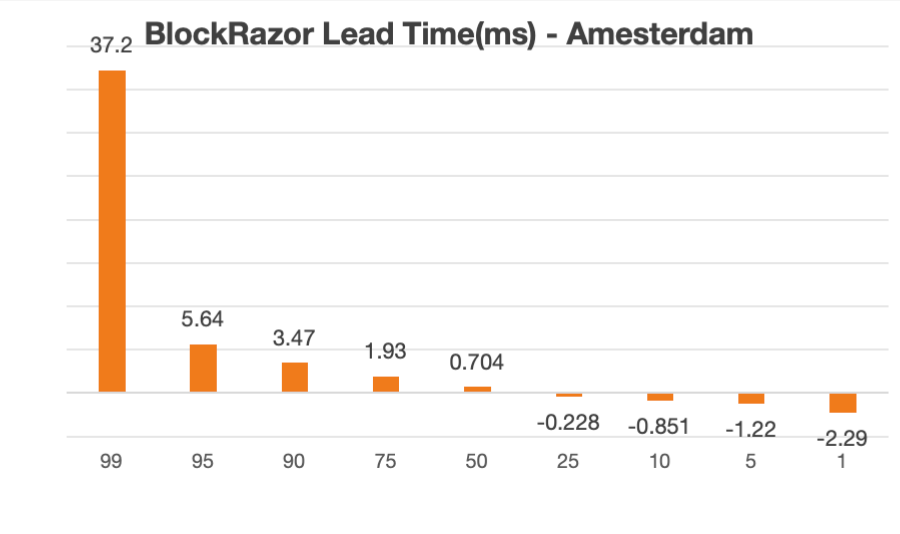
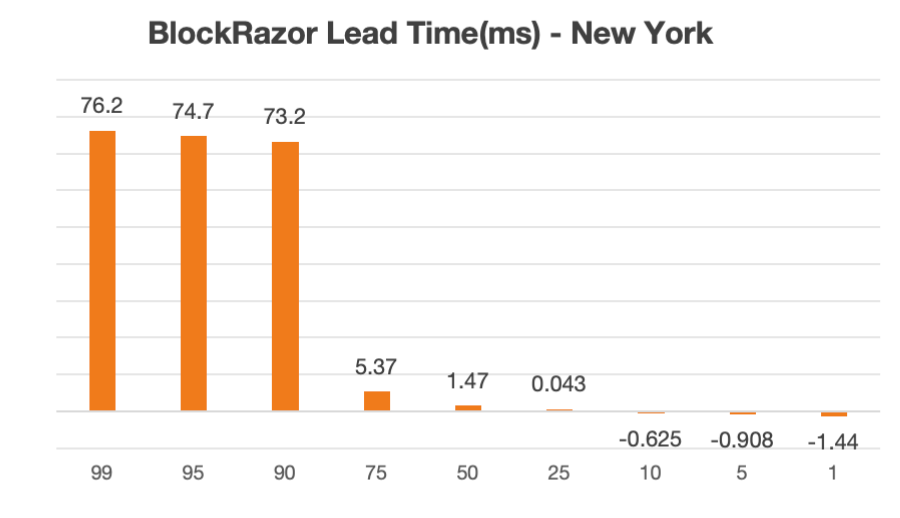
- Overall, BlockRazor outperforms Jito in 75% (P25) of events across all regions, indicating a dominant advantage in most cases. Jito leads in only 10% (P10) of events, with a maximum absolute lead of 1.51ms, suggesting Jito’s advantage is both rare and limited. The gap between P99 and the median is significantly larger than the gap between P1 and the median, showing a left-skewed distribution of lead times, which indicates that BlockRazor’s lead becomes substantially more pronounced at extreme quantiles.
- By region
- Frankfurt: P99=40.1ms, indicating BlockRazor has a significant lead at extreme quantiles; P50=2.14ms, showing BlockRazor maintains a slight lead over Jito under normal conditions.
- Amsterdam: The most competitive region, with a median (P50=0.704ms) close to parity, where BlockRazor holds a marginal lead over Jito.
- New York: P90=73.2ms, demonstrating a highly significant lead for BlockRazor at extreme quantiles; P50=1.47ms, indicating BlockRazor still holds an slight advantage under normal conditions.
- Japan: BlockRazor overwhelmingly dominates Jito, with P99=93.1ms and P50=43.6ms, showing substantial leads across all scenarios; P5=-0.398ms, where Jito slightly outperforms in only 5% of optimal conditions, with minimal overall impact.
Summary
From the above benchmark results, it is evident that BlockRazor Solana Shred Stream outperforms Jito in both "Proportion of Shreds First Arrived" and "Arrival Lead Time of Shred", with a particularly pronounced advantage at extreme quantiles. Jito only maintains a lead in a few cases with relatively weak advantages.
To explore the signal-to-submission workflow, see the Solana transaction sending benchmark, the Solana product page, and the Trading Bots solution.
Shred Stream was officially launched on August 6, 2025 (see ☞ documentation for details). We welcome users interested in Shred Stream to ☞ contact us. For those interested in comparing BlockRazor with other Shred service providers, you can use our open-source ☞ benchmark tool.
'%3e%3cpath%20d='M24.2162%2049.7297L33.2973%2041.9459L48%2039.3513L24.2162%2049.7297Z'%20fill='%23FFFFF2'/%3e%3cpath%20d='M26.95%2033.1959L29.0127%2035.2586L17.2973%2052.3243L39.3513%2032.8648L35.027%2028.9729L49.2973%2012.5404L15.5676%2022.4864L39.7838%2018.1621L26.95%2033.1959Z'%20fill='%23FFFFF2'/%3e%3c/g%3e%3cdefs%3e%3cclipPath%20id='clip0_124_13500'%3e%3crect%20width='55.3514'%20height='64'%20fill='white'%20transform='translate(8.64862)'/%3e%3c/clipPath%3e%3c/defs%3e%3c/svg%3e)