Background
Base chain is an Ethereum Layer 2 solution built by the Coinbase team, based on Optimistic Rollup, providing a low-cost, high-throughput transaction execution environment. Since its launch in 2023, Base has rapidly become a core infrastructure for the DeFi and NFT ecosystems.
To meet the needs of the Base ecosystem, BlockRazor officially launched Base services on September 11, 2025, providing low-latency transaction submission services, block streams, and FlashBlock streams through regionalized gRPC endpoints.
This benchmark focuses on the aforementioned services, conducting a performance comparison between BlockRazor and native Base service, to provide references for Base ecosystem project parties.
Transaction Submission
Benchmark Subject
Base(HTTPS): mainnet.base.org
BlockRazor(gRPC):
- Frankfurt:
frankfurt.grpc.base.blockrazor.xyz:80 - Tokyo:
tokyo.grpc.base.blockrazor.xyz:80 - Virginia:
virginia.grpc.base.blockrazor.xyz:80
Test Method
- Send transfer transactions to the test subjects simultaneously every 2 seconds, for a total of 100 groups
- Prepare BlockRazor and Base client
- Construct two transfer transactions respectively, setting the same gas price
- Simultaneously send the two transactions to the respective test subjects
- Record the block where the transaction was sent, the block where the transaction was included, and the position of the transaction within the block
- Analyze the difference between the transaction sending block and the transaction included block; if the difference is the same, analyze the position within the same block
Test Results
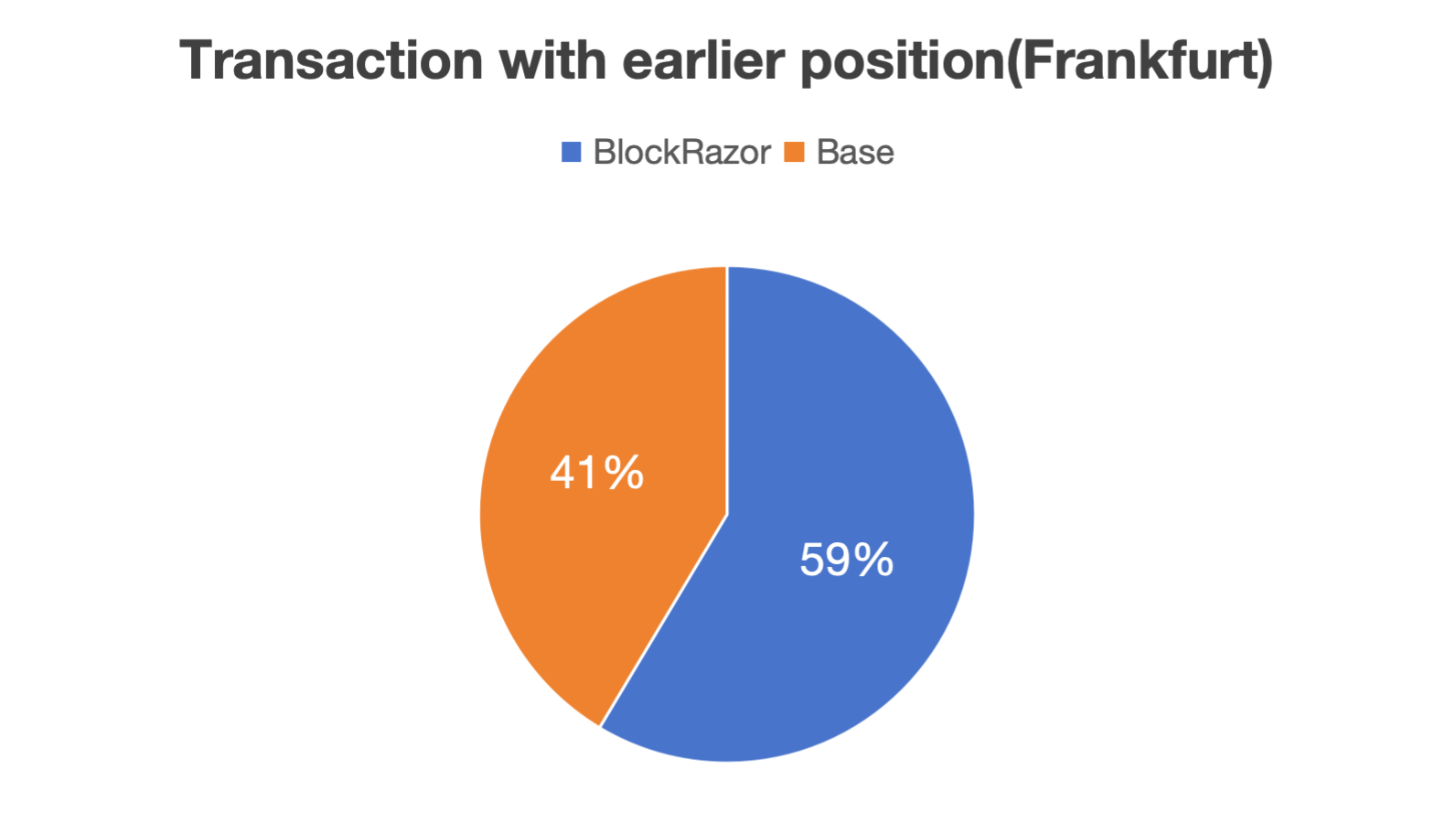
Frankfurt
100 transactions were sent to BlockRazor and Base respectively, for a total of 100 groups
- Number of groups with different block differences: 1, where Base block difference is 2, BlockRazor block difference is 1
- Number of groups with the same block difference: 99. In the same block position comparison results, 58 transactions with earlier position were included by BlockRazor, and 41 transactions with earlier position were included by Base
Tokyo
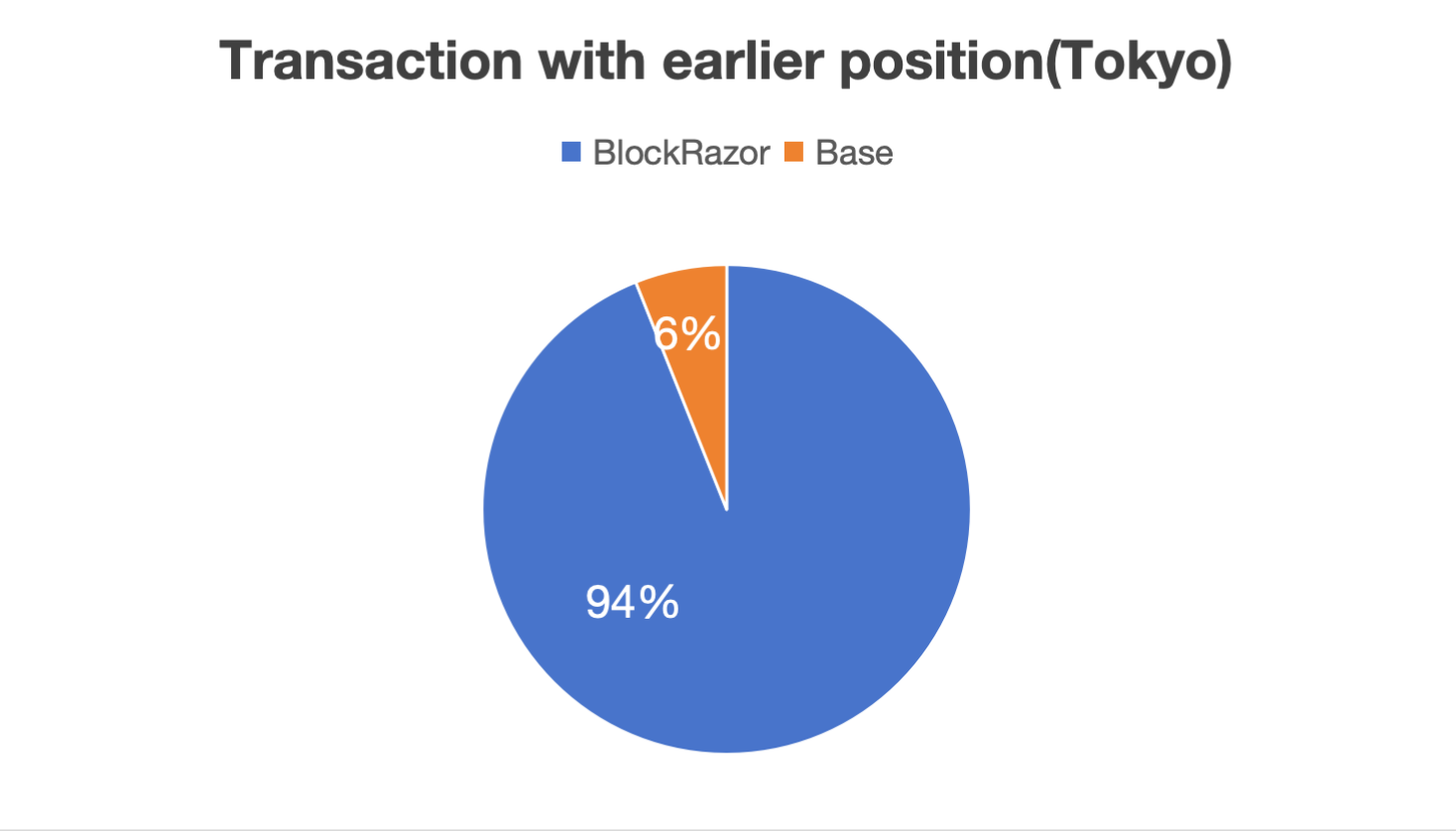
100 transactions were sent to BlockRazor and Base respectively, for a total of 100 groups
- Number of groups with different block differences: 1, where Base block difference is 2, BlockRazor block difference is 1
- Number of groups with the same block difference: 99. In the same block position comparison results, 93 transactions with earlier position were included by BlockRazor, and 6 transactions with earlier position were included by Base
Virginia
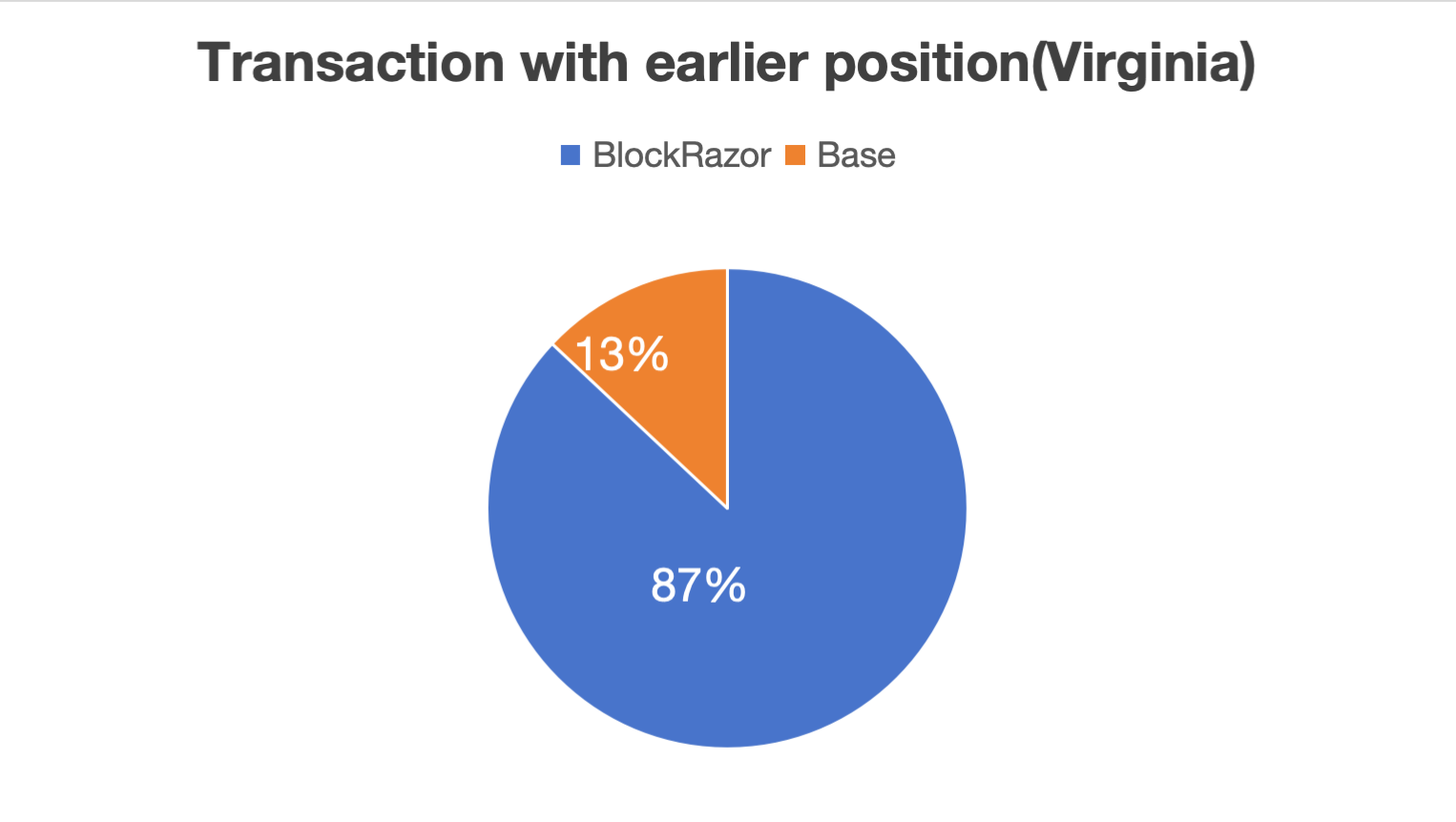
100 transactions were sent to BlockRazor and Base respectively, for a total of 100 groups
- Number of groups with different block differences: 0
- Number of groups with the same block difference: 100. In the same block position comparison results, 87 transactions with earlier position were included by BlockRazor, and 13 transactions with earlier position were included by Base
Summary
- The two test subjects are evenly matched in the comparison of block differences for transaction inclusion; in 300 groups of tests across 3 regions, only 2 groups showed differences in block values, where Base block difference is 2 and BlockRazor is 1
- In terms of block transaction sorting, BlockRazor has a higher proportion of transactions with earlier position, with an occupancy rate of at least 58.59% across all regions, and the most significant advantage in the Asia (Tokyo) region, where the proportion of transactions with earlier position reaches 93.93%
Block Stream
Test Method
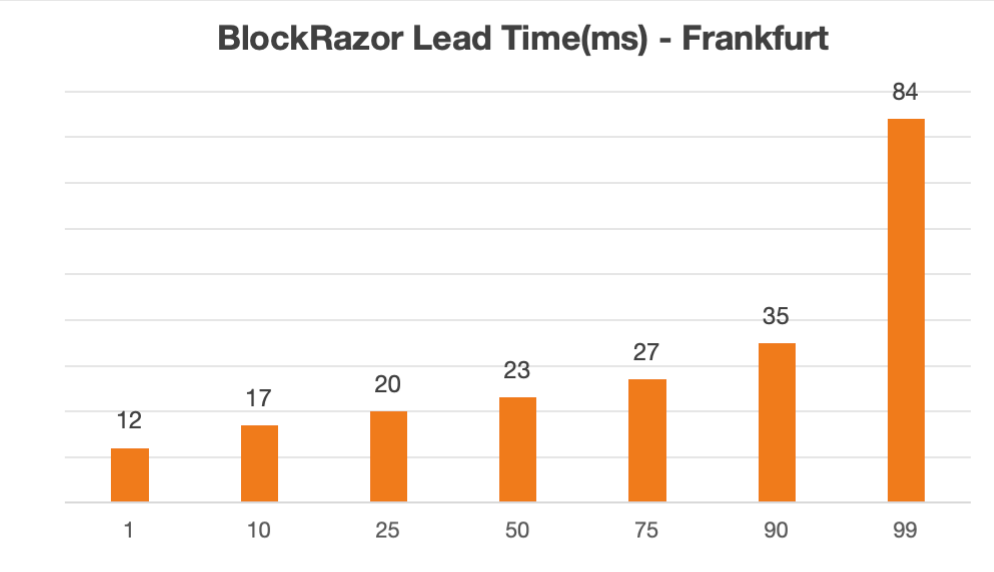
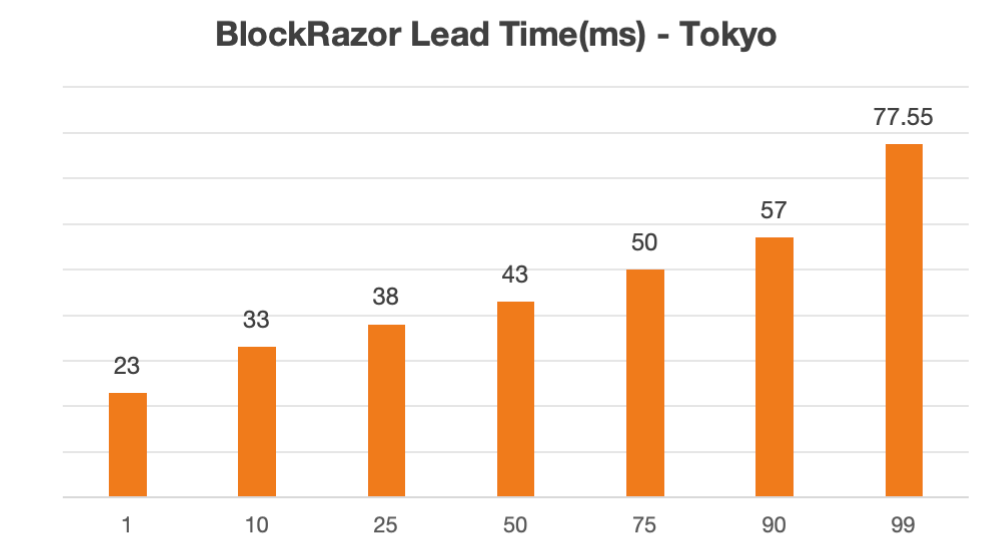
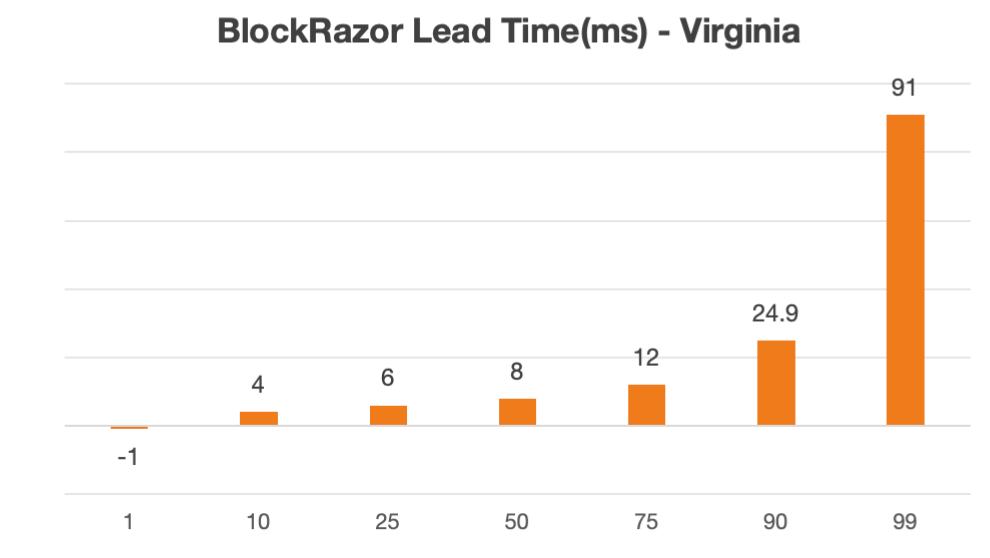
- Deploy test clients in Tokyo, Frankfurt, and Virginia respectively. Each region's test client receives blocks from BlockRazor's corresponding regional relay and from the P2P network, recording the respective block reception timestamps. The test runs for 6 hours, from September 18, 2025, 06:00-12:00 (UTC+8).
- Record and compare the lead time of receiving blocks from BlockRazor versus from the P2P network, and calculate the percentiles of the lead time.
Test Results
Summary
- BlockRazor demonstrates advantages in block reception latency compared to the P2P network across all three regions
- BlockRazor significantly leads in the mid-to-high percentiles (P50-P99) across the three regions, with the lead time distribution exhibiting positive skewness, and the advantage in extreme percentiles expanding dramatically; BlockRazor's low percentiles are roughly on par with the P2P network across the three regions, reflecting that the baseline transmission latency is comparable to the P2P network
- BlockRazor's lead advantage is the greatest in the Japan region, with a median of 43ms; in the Virginia region, the overall lead advantage is relatively converged, with a median of 8ms, but reaching 91ms in extreme percentiles
FlashBlock Stream
Test Method
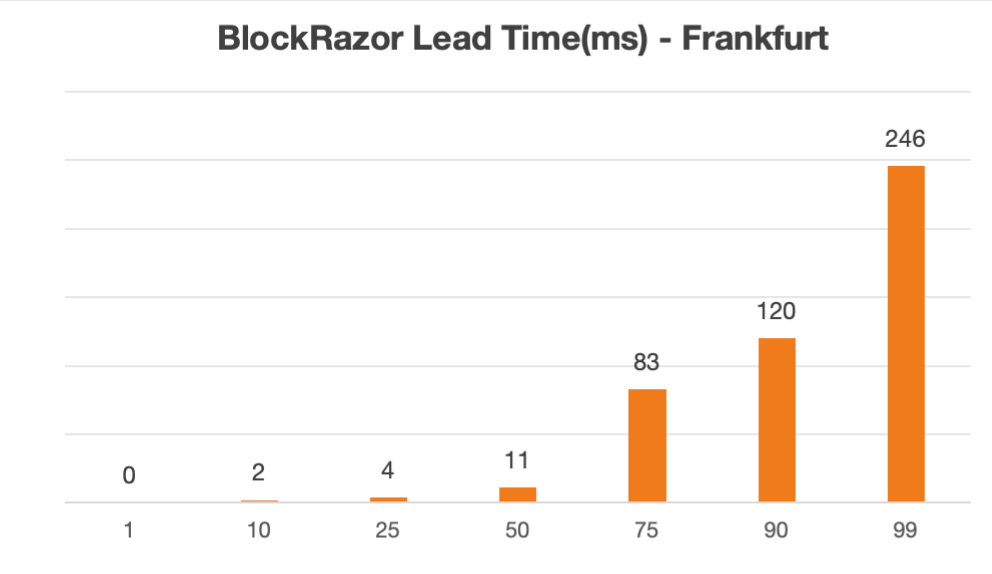
- Deploy test clients in Tokyo, Frankfurt, and Virginia respectively. Each region's test client receives blocks from BlockRazor's corresponding regional relay and from the native Base service, recording the respective block reception timestamps. The test runs for 6 hours, from September 18, 2025, 06:00-12:00 (UTC+8).
- Record and compare the lead time of receiving FlashBlocks from BlockRazor versus from the native Base service, and calculate the percentiles of the lead time.
Test Results
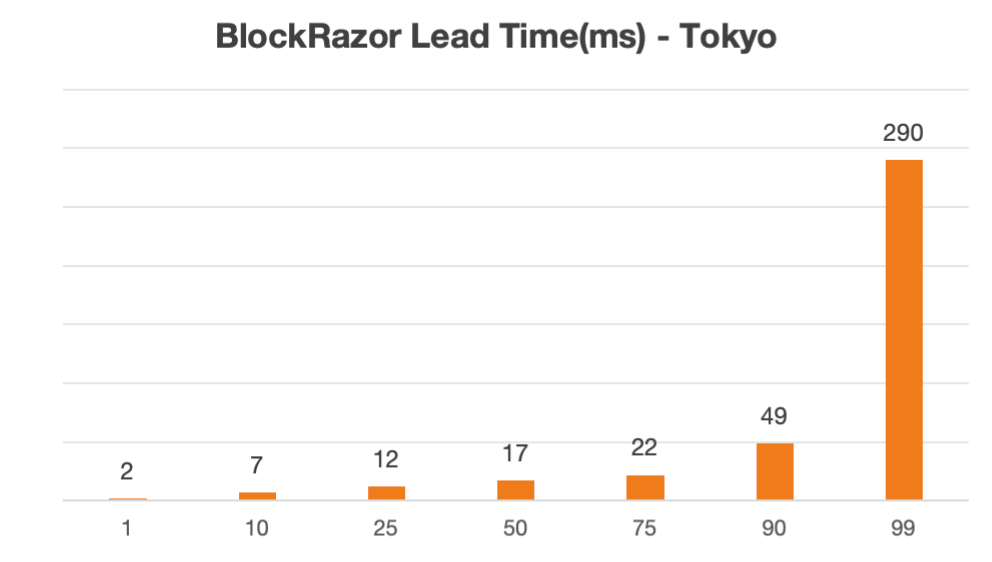
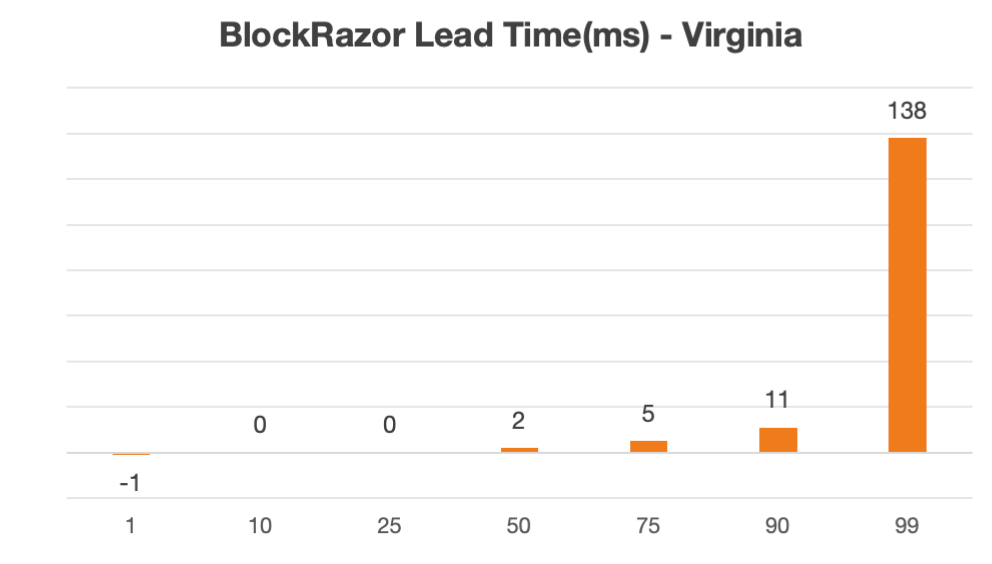
Summary
- BlockRazor demonstrates advantages in FlashBlock reception latency compared to the native Base service across all three global regions
- BlockRazor significantly leads in the mid-to-high percentiles (P50-P99) across the three regions, with the lead time distribution exhibiting positive skewness, and the advantage in extreme percentiles expanding dramatically; BlockRazor's low percentiles are roughly on par with the P2P network across the three regions, reflecting that the baseline transmission latency is comparable to the native Base service
- BlockRazor's lead advantage is larger in the Japan and Frankfurt regions, with medians of 11ms and 17ms respectively, and 99th percentiles of 246ms and 290ms respectively; in the Virginia region, the overall lead advantage is relatively converged, with a median of 2ms and a 99th percentile of 138ms
Summary
This benchmark compares BlockRazor with the native service on the Base chain in terms of transaction submission, Block Stream, and FlashBlock Stream performance. Overall, BlockRazor demonstrates leading advantages in both transaction inclusion latency and block stream data transmission latency.
In transaction submission, the proportion of BlockRazor transactions with earlier positions in the block reaches at least 58.59% across the three regions, with an overwhelming advantage in the Japan region, where the proportion of transactions with earlier positions reaches 93.93%%.
In the comparison of block stream and FlashBlock stream data transmission latency, BlockRazor is roughly on par with the P2P network in low percentiles, while exhibiting positive skewed leading performance in mid-to-high percentiles, with the maximum lead advantage maintained in the Japan region for both.
We welcome Base builders interested in our services to ☞ contact us. We are happy to provide support and collaboration opportunities.