BSC Preconfirmation Mechanism
Preconfirmation is a protocol that allows transactions to be confirmed by the proposer in a time interval significantly shorter than the block time, without altering the consensus process, thereby enhancing the transaction experience.
The essence of the preconfirmation protocol is the early auctioning of a portion of block space, which improves the transaction experience and creates additional block value.
This article primarily studies the economic issues related to the operation of the preconfirmation protocol, based on the following assumptions about the preconfirmation protocol:
- All block builders and validators have deployed the preconfirmation protocol, meaning users can utilize pre-confirmation at any time, rather than being restricted to specific blocks.
- The preconfirmation protocol divides a slot into multiple sub-slots, with the auction logic and pricing logic of each sub-slot being the same.
- The preconfirmation protocol will not have a negative impact on transactions (i.e., it will not lead to fewer transactions or reduced transaction value due to shorter time intervals of sub-slots). This has been discussed in the paper titled "Analyzing the Impact of Shorter Block Times on BNB Smart Chain Validator Revenue from an Atomic Arbitrage Trading Perspective"
BSC Preconfirmation Mechanism Pricing Model
The overall economics of the preconfirmation protocol is closely related to its pricing model. Based on its nature of auctioning limited block space in advance, auctions are a relatively efficient method. In this study, we propose using a reserve price auction method for uniform pricing of preconfirmation transactions and investigate the impact of the pricing range on transaction value and block value.
Value Definition
In this study, we will use block value as the primary analytical metric, defined as the total rewards received by validators after a block is produced.
On BSC, block value typically consists of two parts: the gas fees consumed by transactions, bribes and burned fees . This can be expressed as:
By summing the values of all transactions in a single block, we can obtain the block value:
It is important to note that some MEV bots may implement bribes as a separate transaction during the auction competition for MEV opportunities. For the sake of analyzing the characteristics of MEV transactions, we have merged the value of this transaction with MEV transactions in our study.
Data Sources and Data Processing
Due to multiple significant updates on BSC recently, we selected three different time periods for separate analysis and simulation calculations to avoid the impact of these updates.
Session 1
Block Number 47817283 - 48738679: During this period, the block interval was 3 seconds, and the minimum gas price was 1 Gwei.
Session 2
Block Number 48818828 - 49394682: During this period, the block interval was 1.5 seconds, and the minimum gas price was 1 Gwei.
Session 3
Block Number 49452280 - 49855354: During this period, the block interval was 1.5 seconds, and the minimum gas price was 0.1 Gwei.
Rawdata is sourced from the BSC block data.
Anomaly Data Cleaning
We excluded transactions with gas prices below the minimum threshold (Session 1/2: <1 Gwei; Session 3: <0.1 Gwei) because these transactions are not compatible with preconfirmation and cannot serve as raw data for economic calculations. These transactions typically include:
- 0 Gwei services provided by builders and Validators, such as 0 Gwei transactions from BlockRazor and 48Club.
- Free stablecoin transfers provided by BSC officials, such as transfers of tokens like USDT, USDC, and FUSDT.
It is important to note that when calculating the original and predicted earnings of blocks, the value generated by these transactions will be fully accounted for at its original value. Although these transactions have a negligible impact on block value, we included them for rigor.
Transaction Classification
Different transactions have varying demands for preconfirmation, making it necessary to classify transactions. Ordinary transfer transactions may rarely use preconfirmation, but high-frequency traders and meme users would like to use it.
We classified all obtained transactions as follows:
- Bot Transactions: Transactions generated by platforms such as GMGN, Debot, Dragun, and FourMeme.
- Atomic Transactions: Transactions identified as MEV-Atomic based on smart trading analysis from BlockRazor.
- Nonatomic Transactions: Transactions identified as MEV-Nonatomic based on smart trading analysis from BlockRazor.
- Swap Transactions: Transactions involving the exchange of two or more tokens, primarily sourced from major DEX exchanges (excluding Bot, Atomic, Nonatomic, and Binance Alpha transactions).
- Transfer Transactions: Transfer BNB.
- Transfer (ERC-20) Transactions: Token transfer transactions using Transfer (ERC-20) methods.
- Approve Transactions: Transactions using the Approve method.
- Stake/Unstake Transactions: Transactions related to Stake/Unstake methods.
- Alpha Transactions: Transactions related to Binance Alpha.
- Other: All other undefined transactions.
Pricing
Preconfirmation mechanism allows all transactions to choose between two landing methods: early confirmation through the preconfirmation mechanism or landing through the ordinary method. Preconfirmation provides a better transaction experience, so users need to pay an additional transaction cost for faster confirmation speed which is the extra preconfirmation fee.
Since the preconfirmation mechanism requires the proposer to provide a commitment, the proposer only has the incentive to offer definitive preconfirmation when it can enhance block revenue. Therefore, when discussing pricing, we need to answer the question of which pricing method can increase block revenue.
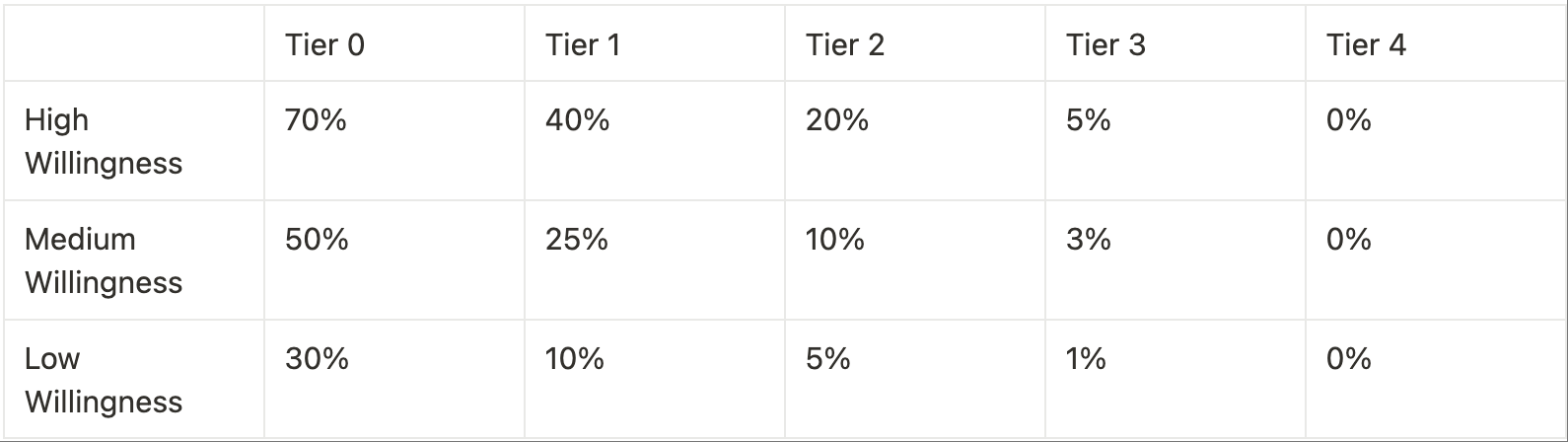
Clearly, not all transactions require the use of preconfirmation; different transactions have varying degrees of demand for it. Thus, when using historical transaction data for calculations, we treated different types of transactions separately:
- Tier 0: Bot Transactions. Meme coins, are highly time-sensitive and thus have the highest demand for pre-confirmation.
- Tier 1: Swap Transactions. Token purchases/sales are conducted through swap transactions, which have a high demand for immediacy.
- Tier 2: Non-atomic Arbitrage Transactions. Under the preconfirmation mechanism, non-atomic arbitrage transactions can capture more price fluctuation differences between CEX and DEX.
- Tier 3: Approve, Stake, Unstake, Transfer, Transfer (ERC-20), Other. In a few scenarios, these transactions may use preconfirmation due to immediacy requirements.
- Tier 4: Atomic Arbitrage, Builder-related Transactions, Alpha Transactions. These have little demand for preconfirmation, or using preconfirmation cannot bring additional reward to the block.
For calculation convenience, we denote the pricing of preconfirmation as GasPrice_Preconf. When a transaction included through preconfirmation, the value of the transaction is given by
meaning the preconfirmation fee is
In the pricing phase, we employed three different pricing strategies, which include:
- Aggressive Pricing: Predicting the auction reserve price for the preconfirmation mechanism based on the 95th percentile of the gas prices from the last five blocks.
- Neutral Pricing: Predicting the auction reserve price for the pre-confirmation mechanism based on the 90th percentile of the gas prices from the last five blocks.
- Conservative Pricing: Predicting the auction reserve price for the pre-confirmation mechanism based on the 80th percentile of the gas prices from the last five blocks.
Additionally, we set a willingness-to-use parameter for preconfirmation, which serves as the proportion of transactions logging in through the preconfirmation mechanism in the simulation calculations
Overall Revenue Analysis
Here are the overall revenue calculation results for Session 1 - Session 3:
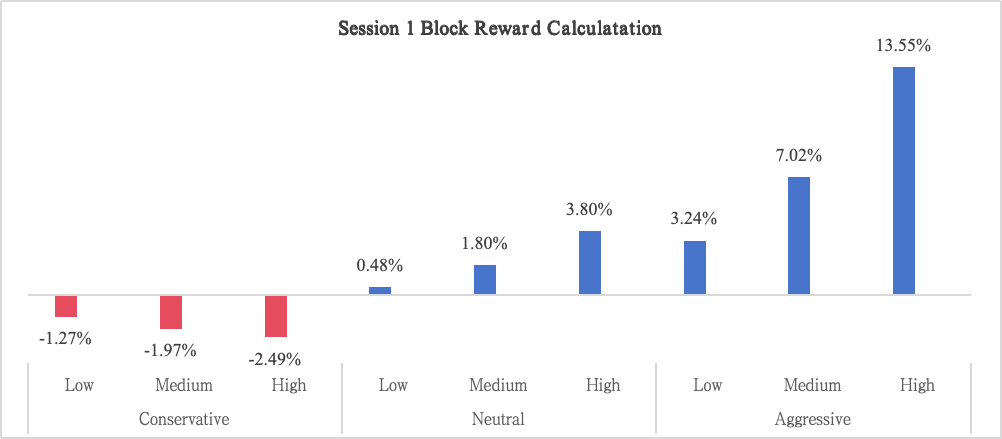
- Session 1: Using an aggressive pricing strategy can lead to a significant increase in block revenue. Under high willingness expectations, preconfirmation can bring a revenue increase of 13.55%. However, when using neutral or conservative pricing strategies, the preconfirmation mechanism does not significantly help the growth of block revenue and may even have a negative effect.
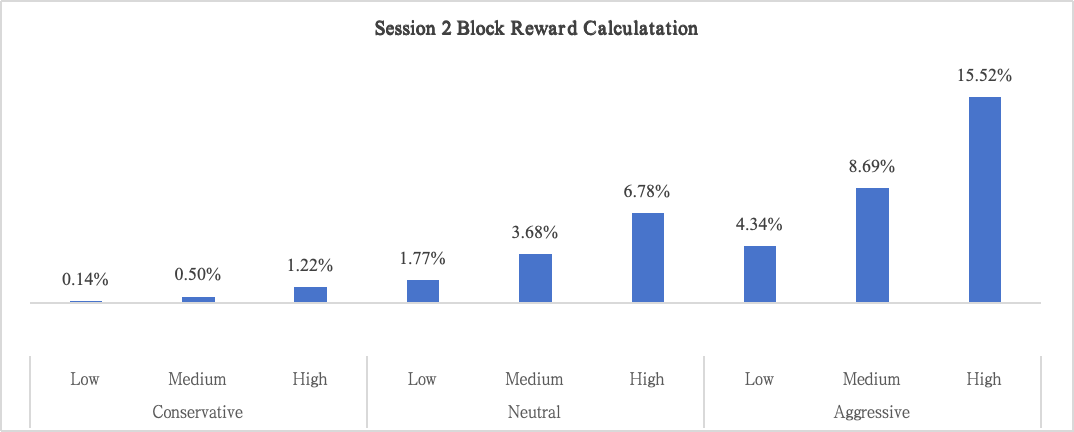
- Session 2: Similar to the results of Session 1, using an aggressive pricing strategy can achieve a notable increase in block revenue, with a revenue growth of 15.52% under high willingness expectations. The difference is that under conservative pricing, the preconfirmation mechanism does not have a negative impact on block revenue, which has drawn our attention. We will further discuss this phenomenon in our subsequent revenue source analysis.
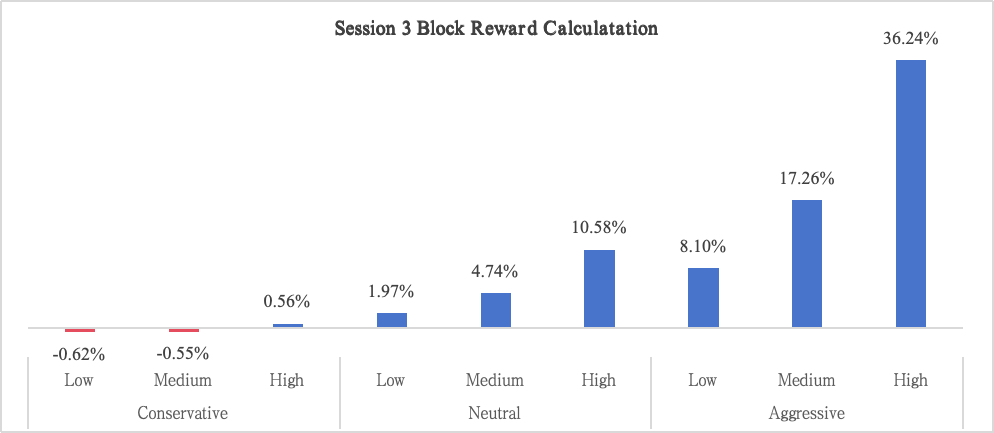
- Session 3: After reducing the minimum transaction fee on BSC from 1 Gwei to 0.1 Gwei, the preconfirmation mechanism has a more significant impact on block reward. Using the aggressive pricing strategy, the block reward growth reaches 36.24% under high willingness expectations, and even under medium willingness expectations, it can generate a revenue increase of 17.26%, which is more substantial compared to the predictions in Sessions 1 and 2.
To facilitate a more intuitive comparison of block revenue across different periods, we used a unified baseline to horizontally compare the calculation results of each session—using the original reward per block from Session 1 as the unified baseline to observe changes in revenue per block under different conditions.
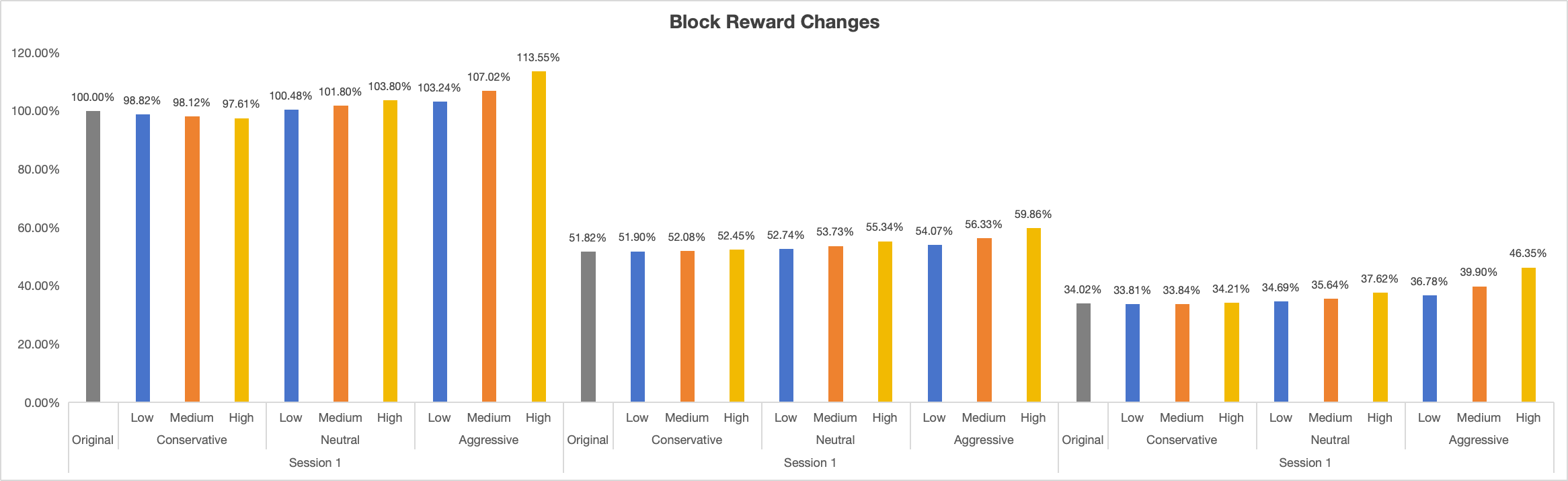
When the block interval is reduced from 3 seconds to 1.5 seconds, the average revenue per block does not show significant changes and may even improve (100% → 51.82%). This aligns with our analysis conclusion that reducing block interval does not affect total block reward. In 0.1Gwei era, BSC's activity significantly increases, but block reward experiences a notable decline, with block reward only at two-thirds of the previous amount. The preconfirmation mechanism effectively compensates for the block revenue loss caused by the decrease in transaction fees. Under the highest revenue expectations, implementing the pre-confirmation mechanism can bring block revenue close to the levels seen during the 1 Gwei period.
Revenue Source Analysis
We studied the total value changes of transactions in different groups (Tier 0 - Tier 4) under various prediction conditions, which helps us understand which transactions contribute more to block value.
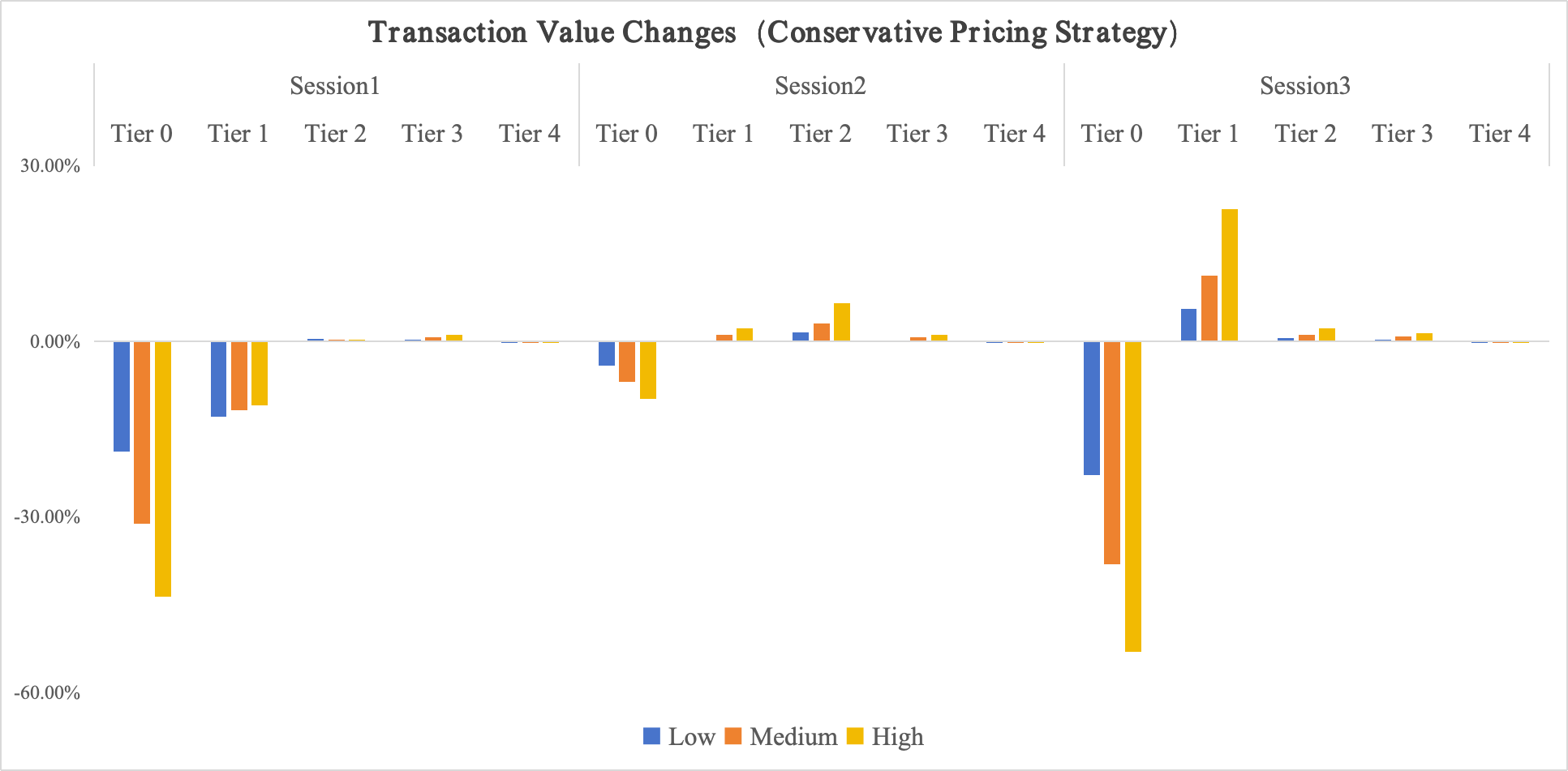
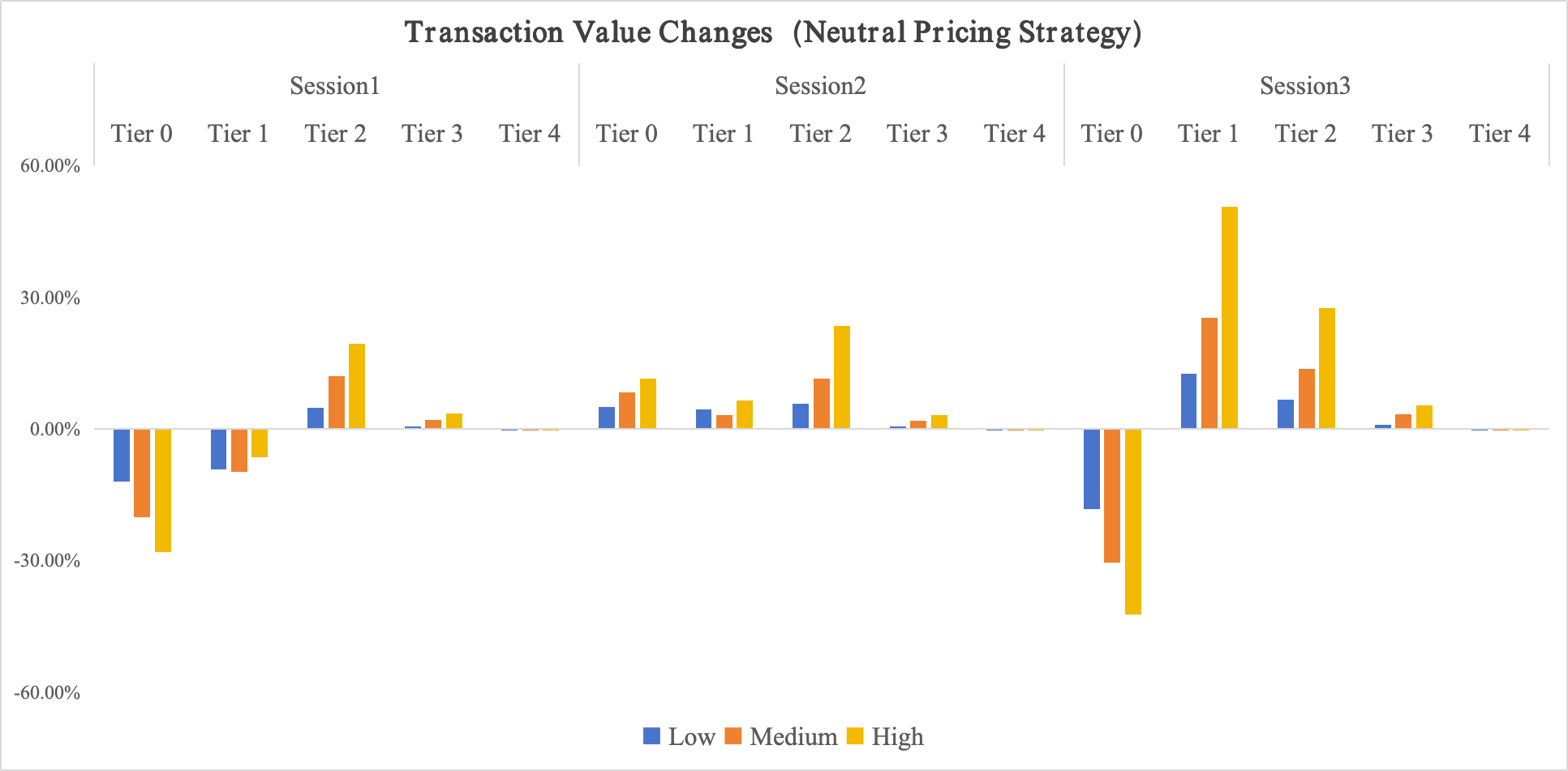
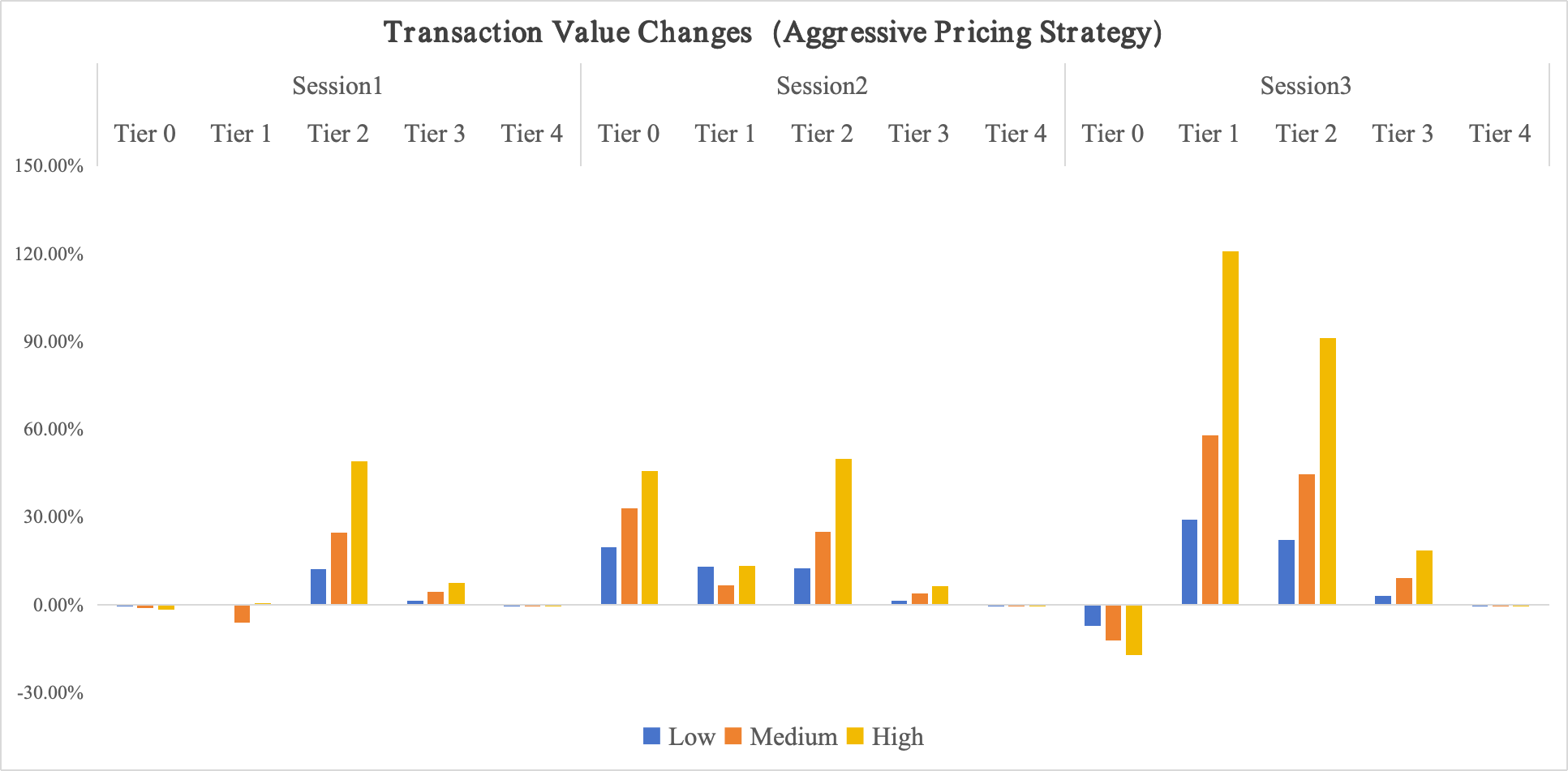
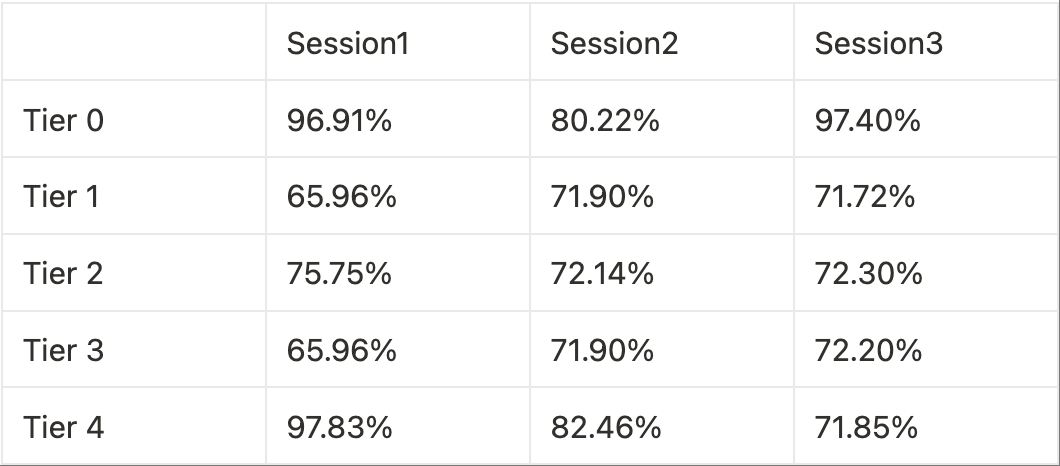
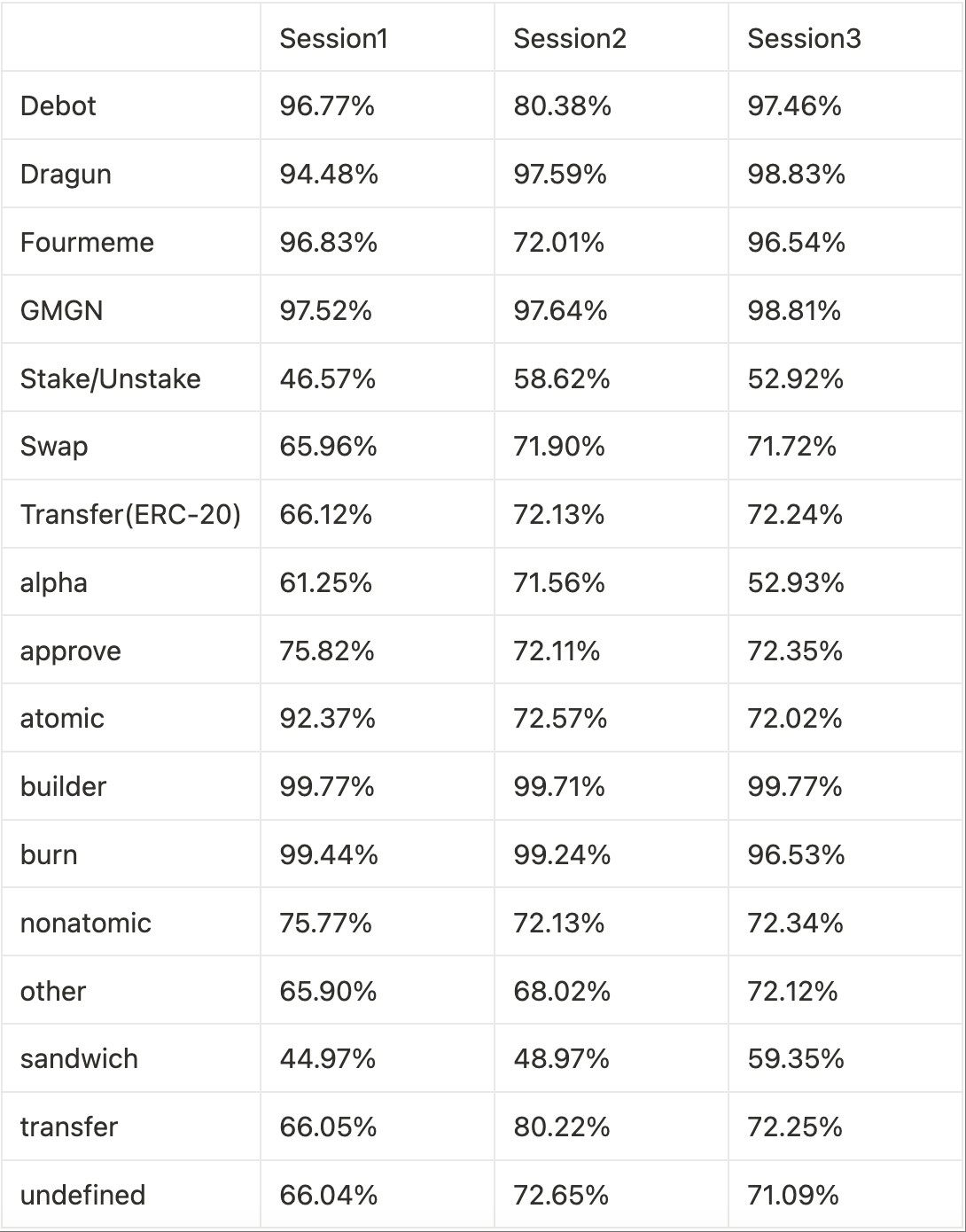
We observed that the value growth of Tier 1 and Tier 2 transactions is quite significant, while Tier 0 transactions show value loss under almost all calculation conditions. This is closely related to the GasPrice of Tier 0 transactions. The following chart shows the GasPrice distribution for different Tier types in each session, which somewhat represents the costs these transactions are willing to pay for rapid on-chain processing and obtaining a favorable landing position (detailed Tier data and transaction type data can be found in the appendix).
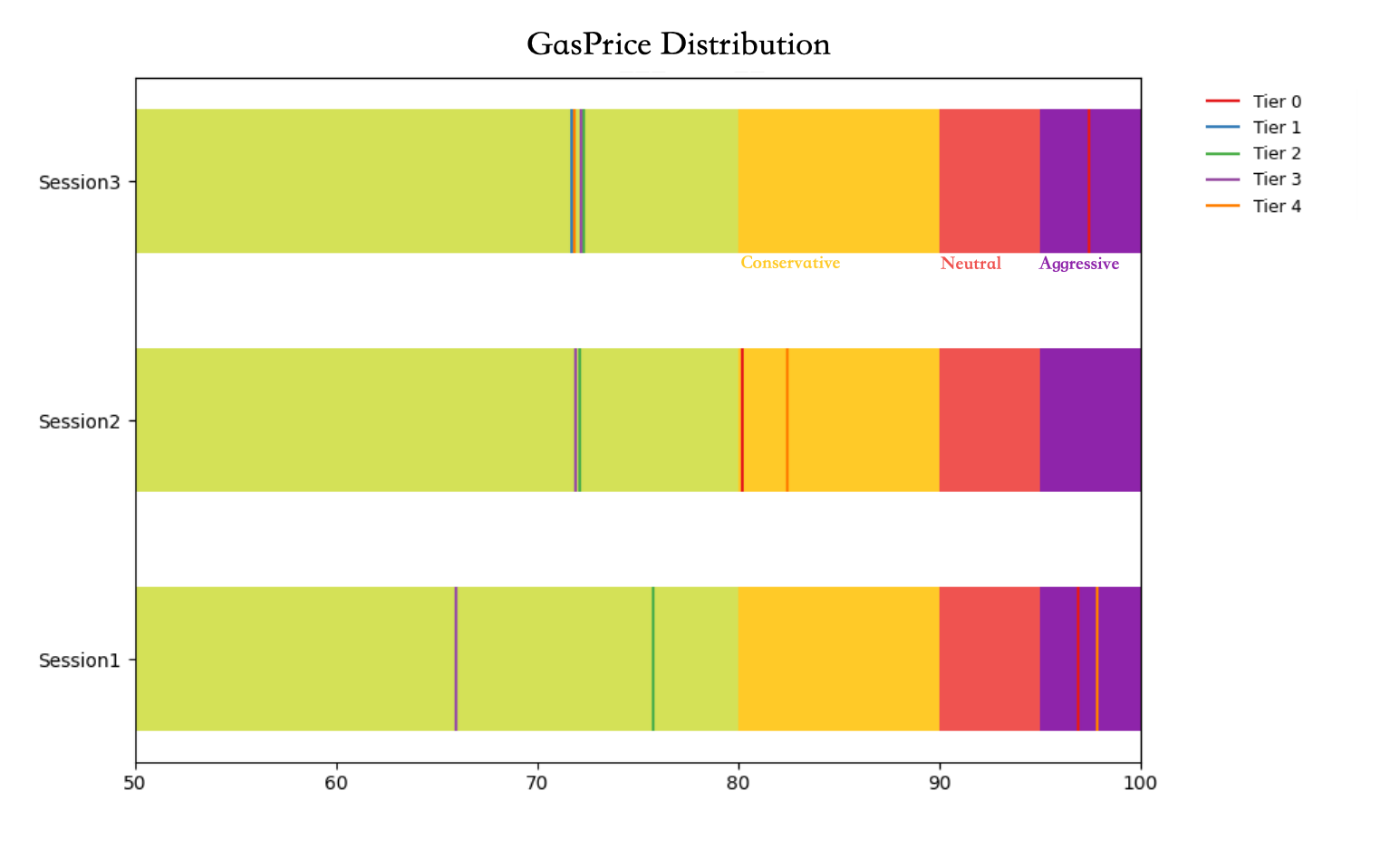
Transactions in the Tier 0 group have the highest GasPrice percentiles: 96.91% in Session 1, 80.22% in Session 2, and 97.40% in Session 3. The auction reserve price of the aggressive pricing strategy is below the average GasPrice of Tier 0, leading to some negative contribution results in the previous calculations for Sessions 1 and 3. The GasPrice percentiles for Tiers 1 to 3 consistently remain below the conservative pricing strategy line, so even when we employ a conservative pricing strategy, these transactions can still contribute additional value to the block.
Further Analysis of Transaction Groups' Contribution to Block Value Enhancement
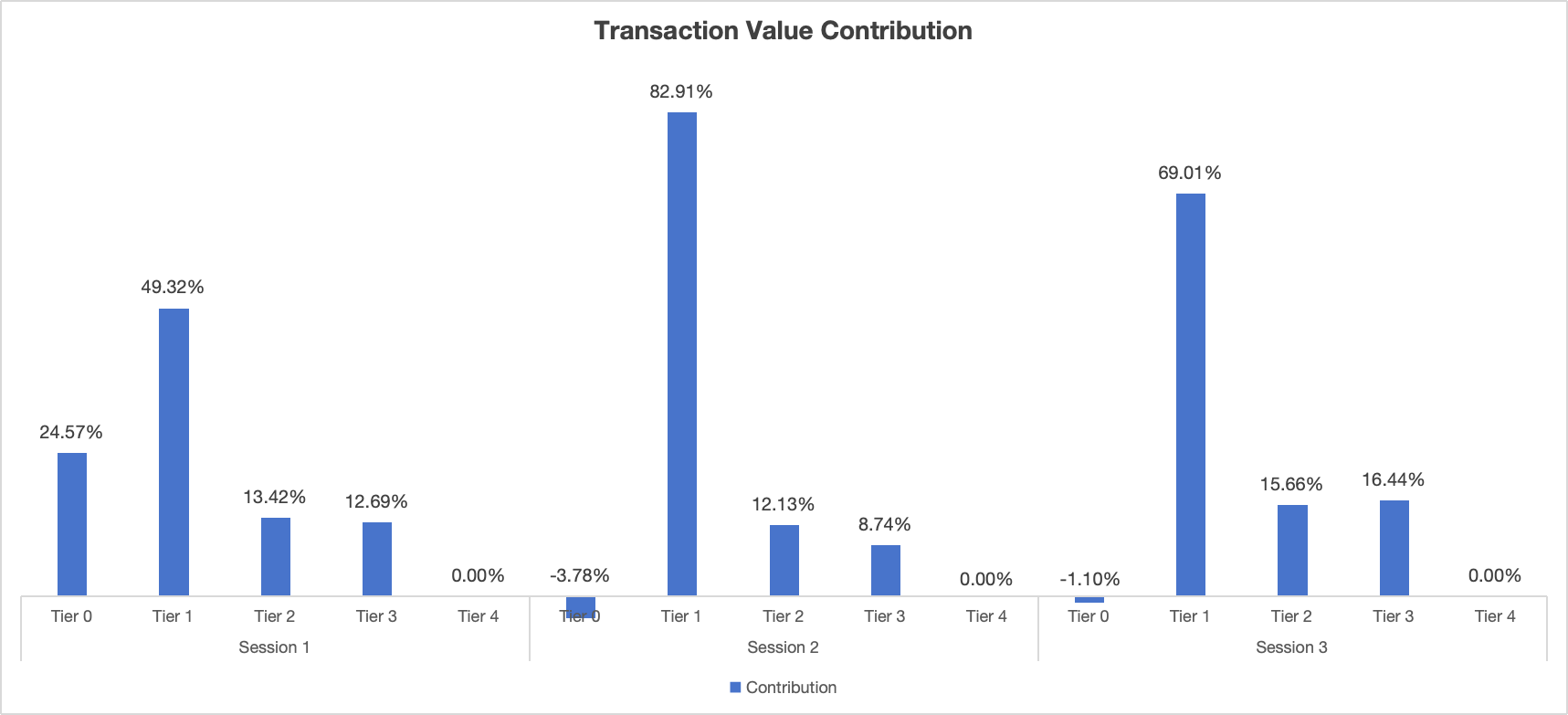
Furthermore, we disaggregated the contributions of different transaction groups to the enhancement of block value. (The differences in results based on various willingness expectation assumptions and pricing strategies are not significant; detailed breakdown results can be found in the appendix.) Under the aggressive pricing strategy and high willingness assumption, the absolute main contributor to block value growth is Tier 1, followed by Tier 2 and Tier 3. This indicates that if preconfirmation adopts a unified pricing model, Tier 0 (Bot transactions) will benefit from both low costs and rapid feedback, while Swap transactions and non-atomic arbitrage transactions will become the primary contributor.
Gas Usage Analysis
If the preconfirmation mechanism auctions too much block space, it may lead to ordinary transactions being unable to go on-chain due to insufficient block space. In this case, the preconfirmation mechanism could have a negative impact on the experience of ordinary transactions.
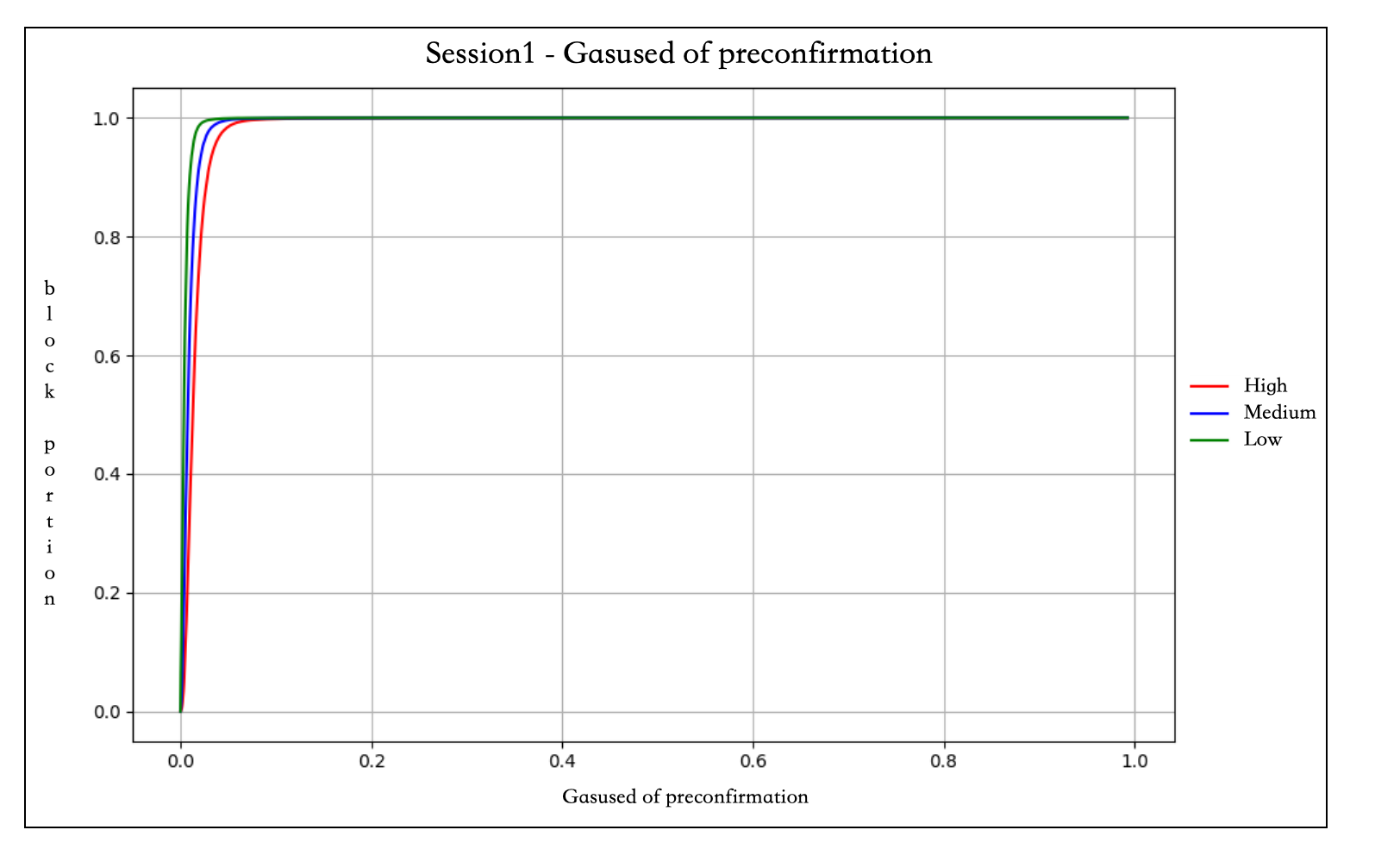
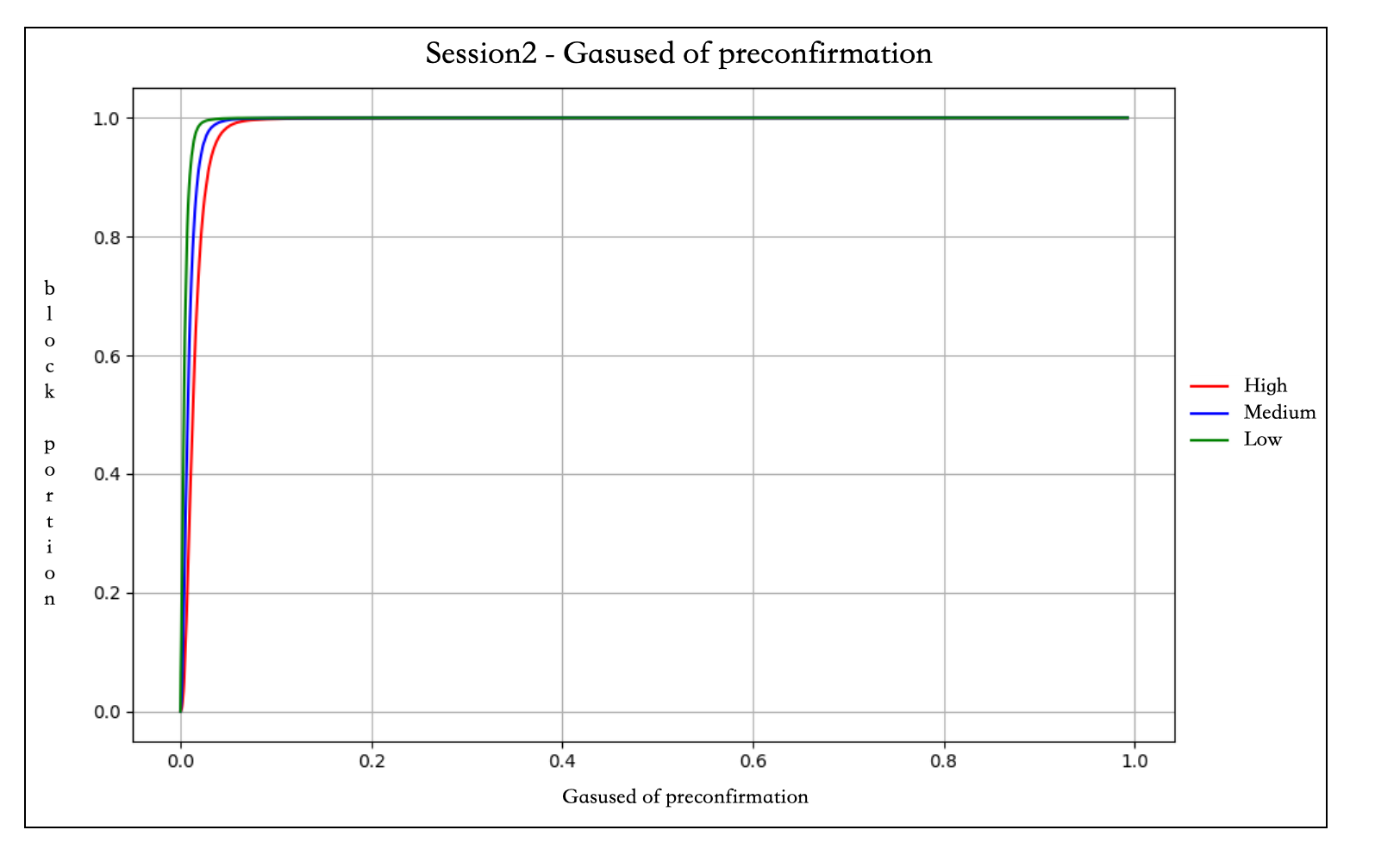
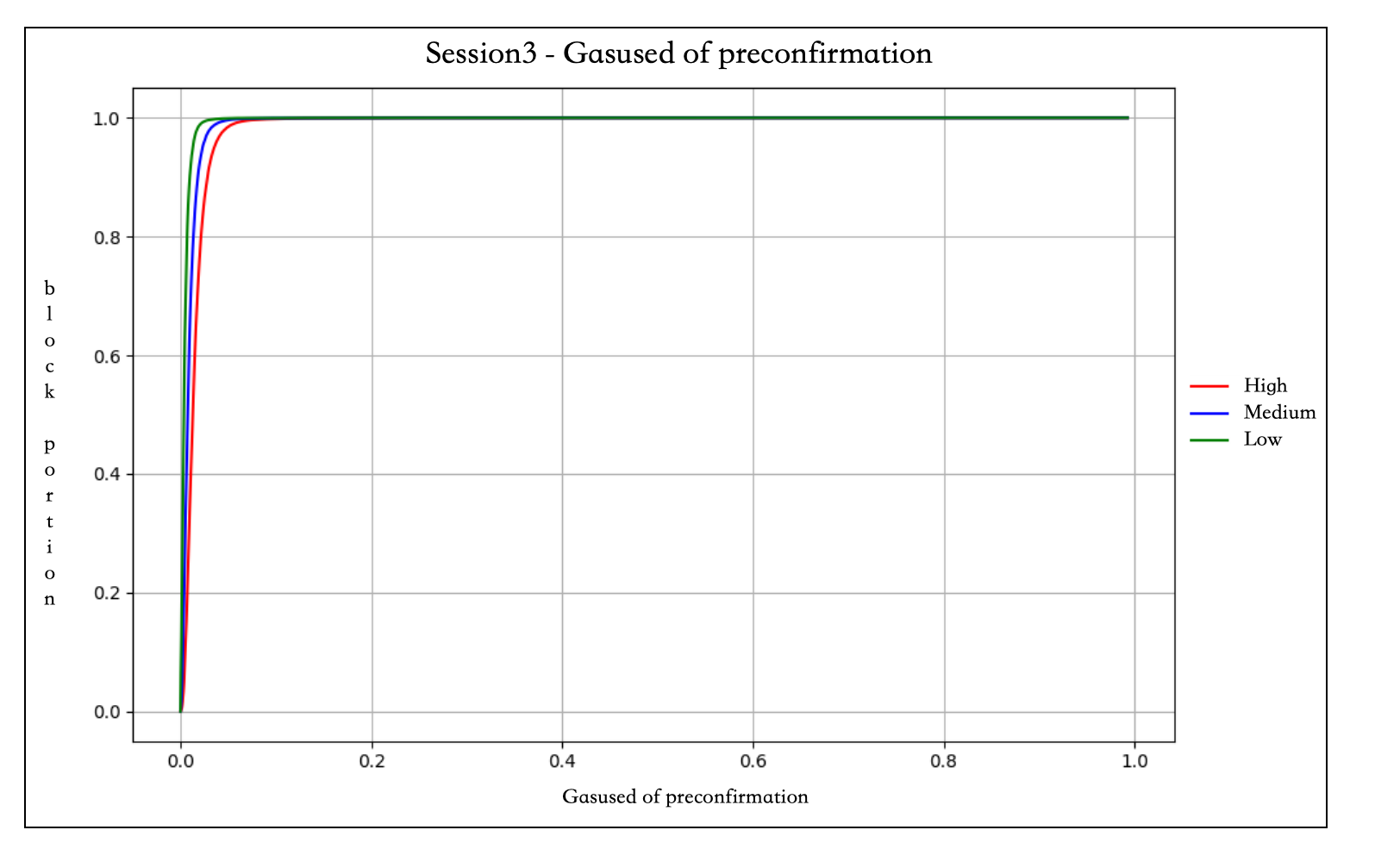
Our calculations indicate that this concern is entirely unwarranted. The chart below shows the block space usage of preconfirmation transactions in each session. Even if we assume that users’ enthusiasm for using preconfirmation is unprecedented, they occupy at most less than 10% of the block space (in Session 1, blocks auctioning less than 10% of block space accounted for approximately 99.7% of all blocks; in Session 2, this value was 97.1%; and in Session 3, it was 98.0%).
Additionally, we conducted a separate analysis of blocks with high block space usage, selecting blocks with a usage rate greater than 80% (historically, this accounts for a small portion of blocks, even less than 1%). In these blocks, the proportion of block space used by pre-confirmation transactions is also not large, indicating that even in relatively congested situations, pre-confirmation will only use a small portion of block space.
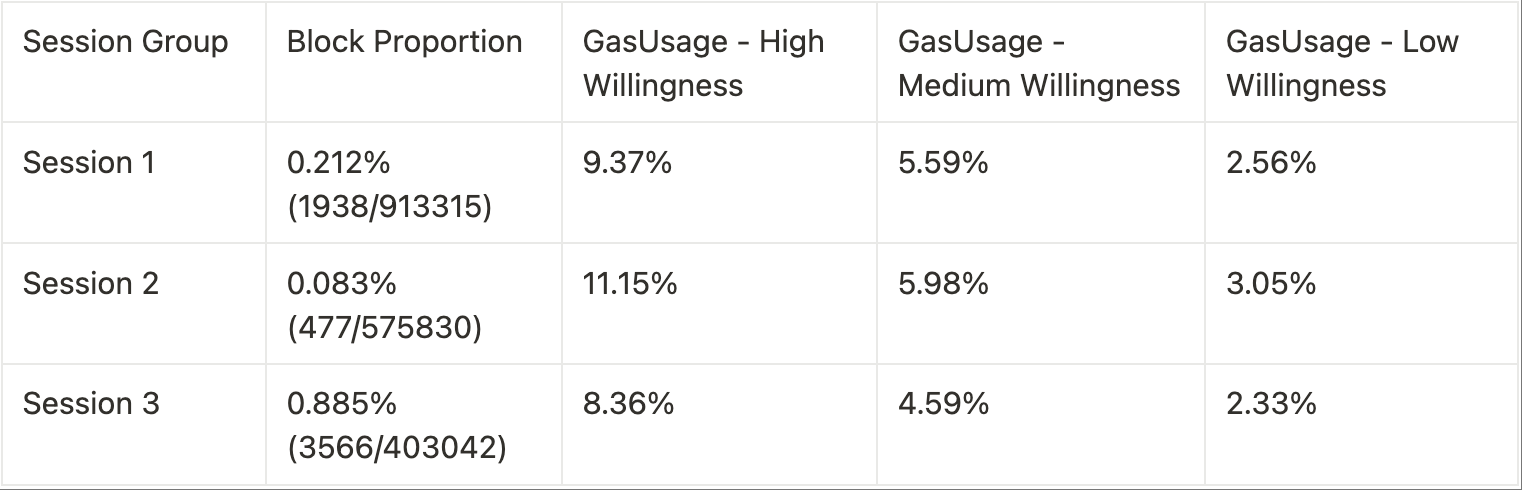
During our calculations, we also found that in very rare cases (0.009% in this analysis), a particular block's preconfirmation transactions could occupy more than 50% of the entire block space, which may impact the experience of ordinary transactions. However, such situations are extremely rare. The designers of the preconfirmation mechanism can further ensure the user experience for ordinary transactions in extreme cases by setting a maximum auction space limit, which would almost not sacrifice the contribution of preconfirmation to block revenue.
Conclusion
- The current BSC environment is suitable for implementing the preconfirmation mechanism. Using an aggressive pricing strategy under high willingness expectations, preconfirmation can bring a 36.24% value enhancement to block value. Operating the preconfirmation mechanism under low Gas Fees (0.1 Gwei) can restore block revenue to levels close to the original Gas Price of 1 Gwei.
- When using a unified pricing model, Bot transactions will simultaneously benefit from lower costs and faster confirmation speeds, while Swap transactions and non-atomic arbitrage transactions will be the main contributors to block reward.
- In the current BSC environment, the preconfirmation mechanism is unlikely to have a negative impact on ordinary transactions, as block space is generally abundant. If the designers of the preconfirmation mechanism wish to maintain the user experience for ordinary transactions in certain extreme cases, setting a maximum block space auction limit (e.g., 50% or even lower) is feasible and will have little impact on preconfirmation revenue.
Appendix
A1. GasPrice Distribution of Group
A2. GasPrice Distribution of Transaction
'%3e%3cpath%20d='M24.2162%2049.7297L33.2973%2041.9459L48%2039.3513L24.2162%2049.7297Z'%20fill='%23FFFFF2'/%3e%3cpath%20d='M26.95%2033.1959L29.0127%2035.2586L17.2973%2052.3243L39.3513%2032.8648L35.027%2028.9729L49.2973%2012.5404L15.5676%2022.4864L39.7838%2018.1621L26.95%2033.1959Z'%20fill='%23FFFFF2'/%3e%3c/g%3e%3cdefs%3e%3cclipPath%20id='clip0_124_13500'%3e%3crect%20width='55.3514'%20height='64'%20fill='white'%20transform='translate(8.64862)'/%3e%3c/clipPath%3e%3c/defs%3e%3c/svg%3e)